Gerald Genta drew the Royal Oak in one night. Audemars Piguet priced steel above gold
At 4:00 PM on April 10, 1970, Managing Director Georges Golay gave designer Gerald Genta one night to sketch an unprecedented steel sports watch. Two years later at the Basel Fair, Audemars Piguet priced that steel watch at 3,300 Swiss francs, 10.4% above its own 18-karat gold dress watch.
 Tat Thang
Get the Weekly Edition by email: the signals that held up and the stories behind them. Free. Subscribe ↗
Steel is a workshop metal. In 1972, every watchmaker in Geneva treated stainless steel as a protective shell for divers, pilots, and railroad engineers who could not risk denting eighteen-karat gold.
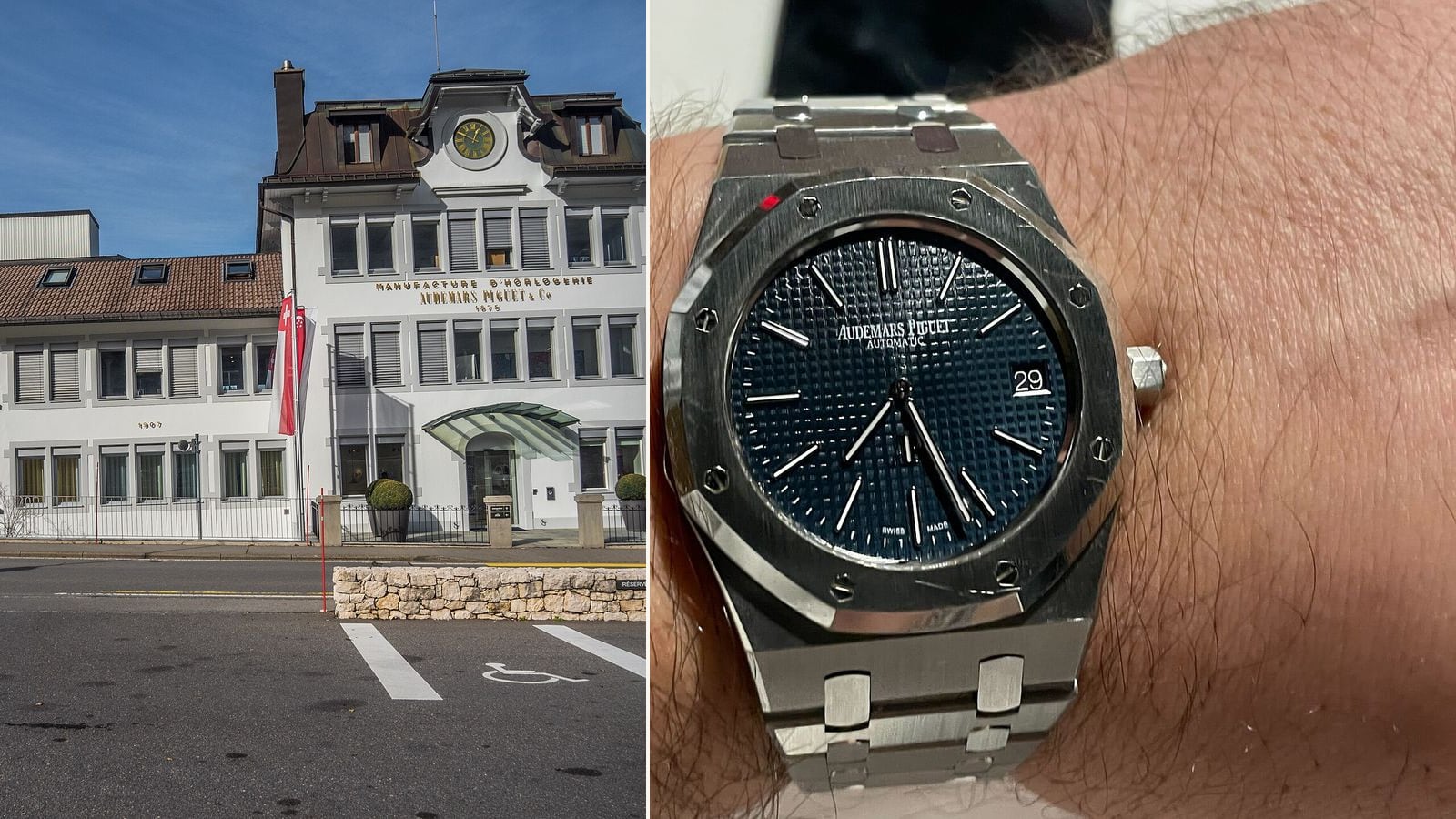
Then a tiny workshop in Le Brassus with eighty-four employees put a stainless steel wristwatch in Showcase No. 545 at the Basel Watch Fair and priced it higher than solid gold.
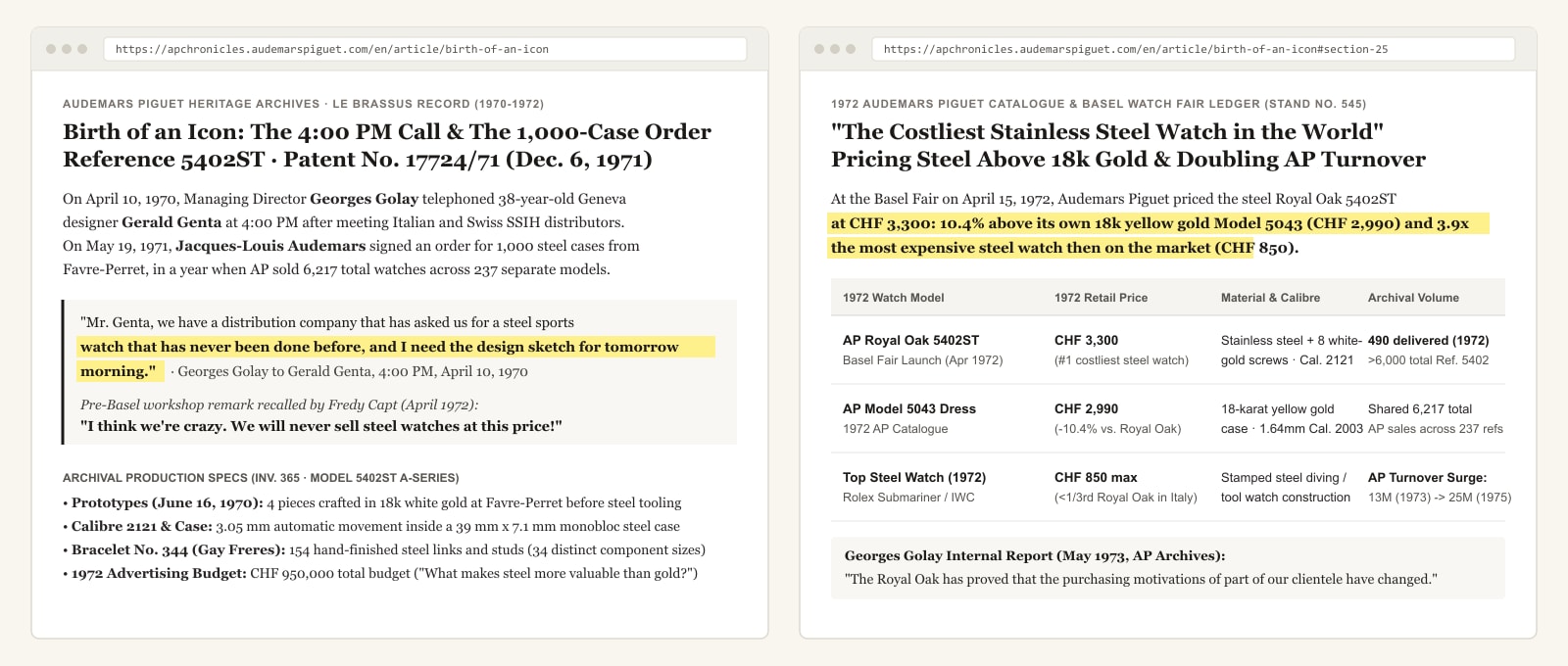
At 4:00 PM on April 10, 1970, Audemars Piguet Managing Director Georges Golay had walked out of a meeting with his Italian and Swiss distributors, Carlo de Marchi, Charles Bauty, and Charles Dorot. They told him the old aristocratic dress-watch market was fracturing and demanded a steel sports watch finished to the standard of haute horlogerie. Golay picked up the telephone and called thirty-eight-year-old Geneva designer Gerald Genta with an overnight deadline: put a steel sports watch that has never been done before on my desk tomorrow morning.
By 9:00 AM on April 11, Genta delivered a gouache-and-pencil rendering on cardboard that became the Royal Oak Reference 5402ST.
The 3,300-franc heresy replaced melt value with The Visible-Labor Premium
Before April 15, 1972, luxury watch pricing followed a lazy commodity rule: the customer paid a high price because the case was cast from yellow gold or platinum. Traditional watchmakers hid every screw, rubber gasket, and hinge underneath a smooth precious-metal bezel so the watch looked like jewelry.
Genta inverted that rule. Drawing on a childhood memory of a deep-sea diver being bolted into a brass helmet along the Rhone, he exposed the functional hardware on the face of the watch. Eight hexagonal white-gold screws passed straight through an octagonal steel bezel, clamping an exposed black rubber gasket against a 39-millimeter monobloc case that measured just 7.1 millimeters thick. Inside beat the 3.05-millimeter automatic Calibre 2121, while the integrated Gay Freres bracelet No. 344 tapered across 154 individual steel pieces in thirty-four distinct component sizes.
When the case maker Favre-Perret in La Chaux-de-Fonds first saw Genta’s blueprint, their jeweler-trained technicians told him it would not work. Because Favre-Perret had never machined high-horology cases in hard steel, the first four Royal Oak prototypes ordered on June 16, 1970 had to be milled out of eighteen-karat white gold simply because white gold was softer to tool than stainless steel.
That manufacturing paradox created The Visible-Labor Premium: when a category is threatened by cheap technology, you cannot defend your margin by hiding inside raw commodity weight. You survive by making the human machining difficulty so visible on the outside of the product that industrial steel commands a higher price than stamped gold.
“I think we're crazy. We will never sell steel watches at this price! If we don't sell them, we'll recover the movements and scrap the cases and bracelets.”
Even inside the Le Brassus workshop, the price terrified the people building the watch. In the Audemars Piguet 1972 catalogue, the company’s own ultra-thin eighteen-karat yellow gold dress watch, Model 5043 powered by the 1.64-millimeter Calibre 2003, carried a retail price of 2,990 Swiss francs.
Golay priced the stainless steel Royal Oak Reference 5402ST at 3,300 Swiss francs: 10.4% more expensive than Audemars Piguet’s own gold dress watch, nearly four times the costliest steel watch then on the market (850 Swiss francs), and more than triple the Italian retail price of a steel Rolex Submariner.
FIG. 01 · THE ROYAL OAK GAMBLE
In April 1972, Audemars Piguet priced the steel Royal Oak at 3,300 CHF, 10% above its own 18k gold dress watch.
Launch pricing and production economics of the 1972 Audemars Piguet Royal Oak Reference 5402ST (Basel Fair, April 1972)
| Benchmark | 1972 retail price | Case & movement | Strategic outcome |
|---|---|---|---|
| AP Royal Oak Ref. 5402ST (1972) | 3,300 CHF (1,000 A-series)AP Chronicles: Birth of an Icon (Royal Oak 5402) | Steel 39mm, Calibre 2121AP Chronicles: Birth of an Icon (Royal Oak 5402) | >6,000 Ref. 5402 soldAP Chronicles: Birth of an Icon (Royal Oak 5402) |
| AP Model 5043 Gold (1972) | 2,990 CHF (-10.4% vs steel)AP Chronicles: Birth of an Icon (Royal Oak 5402) | 18k gold, 1.64mm Cal. 2003AP Chronicles: Birth of an Icon (Royal Oak 5402) | 237 refs shared 6,217 salesAP Chronicles: Birth of an Icon (Royal Oak 5402) |
| Prior Top Steel & Submariner | 850 CHF max (<1,100 CHF)AP Chronicles: Birth of an Icon (Royal Oak 5402) | Stamped steel diving caseAP Chronicles: Birth of an Icon (Royal Oak 5402) | Outpriced 3.9x by Royal OakAP Chronicles: Birth of an Icon (Royal Oak 5402) |
Sources: AP Chronicles: Birth of an Icon (Royal Oak 5402), Tat Thang (@tatthang): Gerald Genta & 1972 Royal Oak. On May 19, 1971, Jacques-Louis Audemars ordered 1,000 steel cases from Favre-Perret. AP turnover nearly doubled from 13M CHF in 1973 to 25M CHF in 1975.
Why a 1,000-unit bet saved a fragmented catalogue of 237 micro-models
To understand how reckless the Royal Oak looked on paper, look at Audemars Piguet’s production ledger the year before launch.
In 1971, Audemars Piguet sold 6,217 watches in total, but that output was splintered across 237 different models, each subdivided into dozens of dial and precious-metal variations. Only twenty-three models had production runs above one hundred pieces. Some 145 models had runs of fewer than ten watches each, and fifty-five were single one-offs. The firm was operating like a bespoke jewelry job shop at the exact moment Japanese quartz technology and the collapse of the Bretton Woods gold-dollar peg were upending Swiss exports.
On May 19, 1971, Jacques-Louis Audemars signed a purchase order with Favre-Perret for 1,000 stainless steel Royal Oak cases, numbered 1 to 1,000 in what collectors later called the A-Series. Ordering 1,000 identical steel cases in a single batch equaled 16.1% of the company’s entire annual output.
Instead of apologizing for charging gold money for steel, the Geneva advertising agency Hugo Buchser turned the price objection into the headline of a 950,000-franc campaign: “What makes steel more valuable than gold?” and “Would you buy a Rembrandt for its canvas?”
The control group is what happened across the rest of Geneva within four years. By the end of 1972, Le Brassus had produced 565 Royal Oak watches and delivered 490. Annual deliveries crossed 500 units in 1973, reached 618 in 1974, and hit 820 in 1978, ultimately exceeding 6,000 units of Reference 5402 alone across the A, B, C, and D series. Audemars Piguet’s total annual turnover nearly doubled in twenty-four months, climbing from 13 million Swiss francs in 1973 to 18 million in 1974 and 25 million in 1975.
By 1976, Patek Philippe hired Gérald Genta to sketch the steel Nautilus Reference 3700 and launched it at 1,400 British pounds with the copy: “One of the most expensive watches in the world is made of steel.”
Gold sells the material. Craft sells the silhouette. Scarcity sells the wait. When a founder prices visible engineering above raw commodity inputs, the market stops weighing the metal and starts paying for the signature.
Sources & image credits (5)
What would prove this wrong
This analysis is falsified if Audemars Piguet archival records (AP Chronicles) show the 1972 Royal Oak Reference 5402ST launched below the 2,990 CHF catalogue price of the 18-karat yellow gold Model 5043 or failed to expand Manufacture turnover from 13 million CHF in 1973 to 25 million CHF in 1975.
Sources
- [1] AP Chronicles (Audemars Piguet Heritage Archive): Birth of an Icon (Royal Oak Model 5402ST) ↗
- [2] AP Chronicles (Audemars Piguet Heritage Archive): Royal Oak Calendar Watches 1983-1996 & Pricing Record ↗
- [3] Tat Thang (@tatthang): Gerald Genta & 1972 Royal Oak overnight sketch dossier (1.06M views on X) ↗
- [4] Tat Thang (@tatthang): Audemars Piguet $400 vs. $30,000 luxury logo psychology (1.28M views on X) ↗
Images: Wikimedia Commons / Jag9889 & OpaleHorse, CC BY-SA 4.0, split composite, metadata removed
The Uncut Notebook on Substack
The Weekly Edition, plus what stays off this site: operator playbooks, uncut onchain wallet dossiers, and notes from the system behind this notebook. No spam, no paywall.
Subscribe on Substack ↗