Paul Otellini turned down the first iPhone chip on paper margins. TSMC built a $1.65 trillion empire on the volume
In 2006, Intel stood at $116.8 billion in market value, more than double TSMC at $56.5 billion, when Steve Jobs asked CEO Paul Otellini to fabricate the first iPhone processor. Intel walked away over a fixed unit-price ceiling, sold its ARM mobile division for $600 million, and handed the 3-billion-unit mobile and AI foundry flywheel to Taiwan.
 Tat Thang
Get the Weekly Edition by email: the signals that held up and the stories behind them. Free. Subscribe ↗
Spreadsheets protect last decade’s gross margin. They almost never see next decade’s volume curve.
In 2006, Intel sat atop the global semiconductor industry at a year-end market capitalization of $116.78 billion, more than double Taiwan Semiconductor Manufacturing Company (TSMC) at $56.46 billion. Twelve months earlier, at Apple’s June 2005 Worldwide Developers Conference, Steve Jobs had stood onstage beside Intel Chief Executive Officer Paul Otellini in a clean-room bunny suit to announce that Apple was migrating the entire Macintosh line from PowerPC to Intel x86 silicon.
So when Jobs needed a custom application processor for a secret mobile handset scheduled to launch in 2007, he brought the contract to Santa Clara first.
Apple laid down one non-negotiable condition: a fixed unit price ceiling. As Otellini later recounted, Apple offered a specific dollar amount per chip and promised “not a nickel more.” Intel’s finance team ran the wafer cost projections against its x86 desktop and Xeon server margins, concluded that an untested Apple phone would never ship enough volume to amortize the custom engineering cost, and said no.
How a 100x volume blind spot triggered The Foundry Flywheel Transfer
To see why that single spreadsheet decision rewired the balance of power in global computing, you have to connect two transactions Intel made in the same summer of 2006.
First, Intel declined Apple’s fixed-price iPhone contract because low-margin mobile silicon looked like a distraction from 60-percent gross margin PC and server processors. Second, on June 27, 2006, Intel sold its own ARM-based mobile communications processor division, XScale, to Marvell Technology Group for $600 million in cash and shares so management could concentrate capital on x86.
Apple walked out of Santa Clara and built the 2007 iPhone on an ARM instruction set, initially contracting Samsung to fabricate the early application processors before bringing chip architecture in-house with the A4 in 2010.
“We ended up not winning it or passing on it, depending on how you want to view it. My gut told me to say yes. In hindsight, the forecasted cost was wrong and the volume was 100x what anyone thought.”
Seven years later, in May 2013, on the eve of his retirement after forty years at Intel, Otellini sat down with journalist Alexis Madrigal of The Atlantic and named the iPhone refusal as the defining regret of his tenure. His own instinct had favored taking the contract, yet he allowed internal cost models to overrule him. In hindsight, Otellini admitted, Intel’s forecasted wafer cost was wrong and the actual unit volume came in 100 times higher than anyone inside Intel’s planning models had projected.
That admission defines The Foundry Flywheel Transfer: in capital-intensive hardware, leading-edge process nodes are not funded by protecting high percentage margins on a stagnating platform. They are funded by capturing the highest-volume consumer product of the new era, because guaranteed billion-unit wafer runs pay for the next lithography machine before competitors can justify the capital expenditure.
FIG. 01 · THE IPHONE FOUNDRY SHIFT
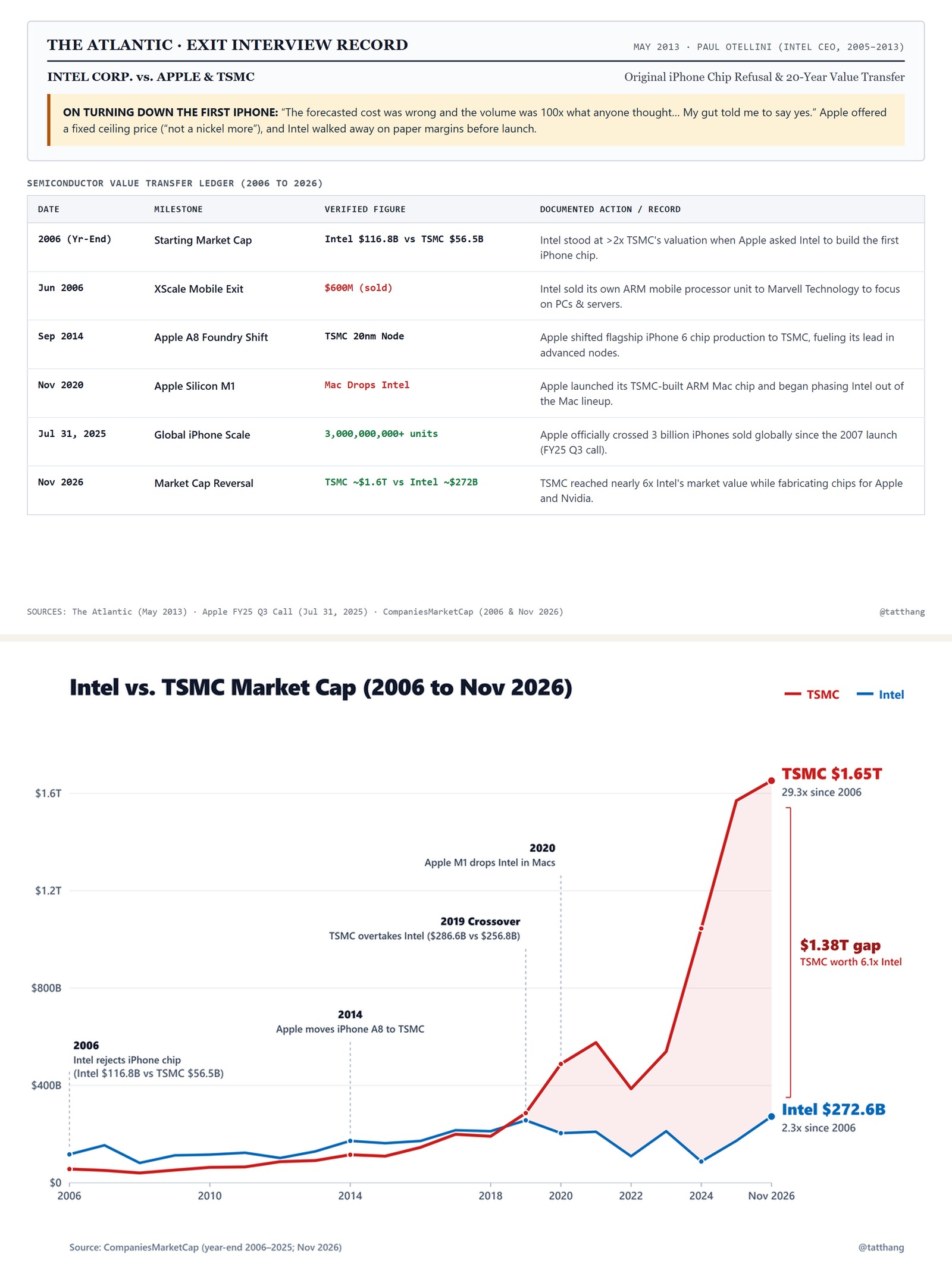
In 2006, Intel stood at $116.8B, double TSMC at $56.5B. By Nov 2026, TSMC reached $1.65T versus Intel at $272.6B.
Twenty-year valuation and silicon foundry transfer after Intel rejected the original 2007 iPhone processor
| Entity & architecture | 2006 year-end value | Nov 2026 valuation | Foundry outcome |
|---|---|---|---|
| Intel Corp. (x86 / IDM) | $116.78B (2.1x TSMC)CompaniesMarketCap: TSMC & Intel Valuations (2006-2026) | $272.55B (+133% vs 2006)CompaniesMarketCap: TSMC & Intel Valuations (2006-2026) | Sold XScale ARM for $600MThe Atlantic: Paul Otellini Exit Interview (May 2013) |
| TSMC (Pure-Play Foundry) | $56.46B (48% of Intel)CompaniesMarketCap: TSMC & Intel Valuations (2006-2026) | $1.652T (29.3x vs 2006)CompaniesMarketCap: TSMC & Intel Valuations (2006-2026) | Fabs Apple A-series, M1, NVDACompaniesMarketCap: TSMC & Intel Valuations (2006-2026) |
| Apple iPhone & Mac Silicon | Fixed unit price ceilingThe Atlantic: Paul Otellini Exit Interview (May 2013) | 3,000,000,000+ iPhonesTat Thang (@tatthang): Intel vs. Apple & TSMC Dossier | 2014 A8 20nm & 2020 M1 shiftTat Thang (@tatthang): Intel vs. Apple & TSMC Dossier |
Sources: The Atlantic: Paul Otellini Exit Interview (May 2013), CompaniesMarketCap: TSMC & Intel Valuations (2006-2026), Tat Thang (@tatthang): Intel vs. Apple & TSMC Dossier. Paul Otellini confirmed in May 2013 that Intel underestimated iPhone volume by 100x. TSMC overtook Intel in market cap in 2019 ($286.6B vs. $256.8B).
Why losing the iPhone in 2006 cost Intel the Mac in 2020 and AI in 2026
Once Intel surrendered the iPhone socket, the capital compounding moved across the Pacific in three locked stages.
- Stage I: The 2014 20nm Foundry Shift. By September 2014, Apple wanted its flagship iPhone 6 chip off the production lines of its primary smartphone rival, Samsung. Apple awarded the A8 processor on a 20-nanometer node to TSMC. Every autumn iPhone upgrade cycle thereafter acted as an upfront multi-billion-dollar anchor commitment that de-risked TSMC’s extreme ultraviolet (EUV) lithography buildout at 7nm, 5nm, and 3nm.
- Stage II: The 2020 Apple Silicon Boomerang. Armed with fourteen years of mobile ARM design and TSMC’s 5-nanometer fabs, Apple no longer needed Intel inside the Mac either. In November 2020, Apple introduced the M1 chip and systematically phased Intel processors out of its entire laptop and desktop catalog. That year, TSMC’s year-end market value reached $488.12 billion, more than double Intel’s $204.16 billion.
- Stage III: The 3-Billion-Unit AI Silicon Monopoly. On July 31, 2025, during its Q3 FY2025 earnings call, Apple confirmed it had crossed 3 billion iPhones sold worldwide since 2007. Those three billion mobile chips had paid for the exact Taiwanese clean rooms that Nvidia, AMD, Broadcom, and Apple now depend on to fabricate every frontier AI accelerator.
Look at the twenty-year scoreboard between December 2006 and November 2026. In 2006, Intel led TSMC by $60.32 billion ($116.78 billion versus $56.46 billion). TSMC crossed above Intel at year-end 2019 ($286.57 billion versus $256.75 billion), widened the multiple gap to 11.9x during Intel’s 2024 trough ($1.045 trillion versus $87.55 billion), and stands in November 2026 at $1.652 trillion (29.3x its 2006 valuation) against Intel’s $272.55 billion (2.3x its 2006 valuation).
Incumbents rarely die because their accountants cannot do arithmetic. They die because their accountants price a new paradigm using the volume assumptions of the old one. When a customer about to ship three billion units asks for a fixed ceiling price, the margin you give up on wafer one is the tuition for owning the foundry twenty years later.
Sources & image credits (5)
What would prove this wrong
This analysis is falsified if primary records from Paul Otellini's May 2013 exit interview in The Atlantic, Intel's June 2006 sale of XScale to Marvell Technology for $600 million, Apple's July 31, 2025 Q3 FY25 earnings call reporting 3 billion iPhones sold, or CompaniesMarketCap historical valuations ($116.78B Intel vs. $56.46B TSMC at year-end 2006; $1.652T TSMC vs. $272.55B Intel in November 2026) are disproven.
Sources
- [1] The Atlantic (Alexis C. Madrigal): Paul Otellini's Exit Interview on Turning Down the Original iPhone Chip (May 2013) ↗
- [2] CompaniesMarketCap Historical Ledger: Taiwan Semiconductor (TSMC) vs. Intel (INTC) Market Capitalization (2006-2026) ↗
- [3] U.S. Securities and Exchange Commission (EDGAR): Intel Corp. & Marvell Technology $600M XScale Divestiture Record (June 2006) ↗
- [4] Tat Thang (@tatthang): Intel vs. Apple & TSMC 2006-2026 iPhone chip refusal dossier (804K views on X) ↗
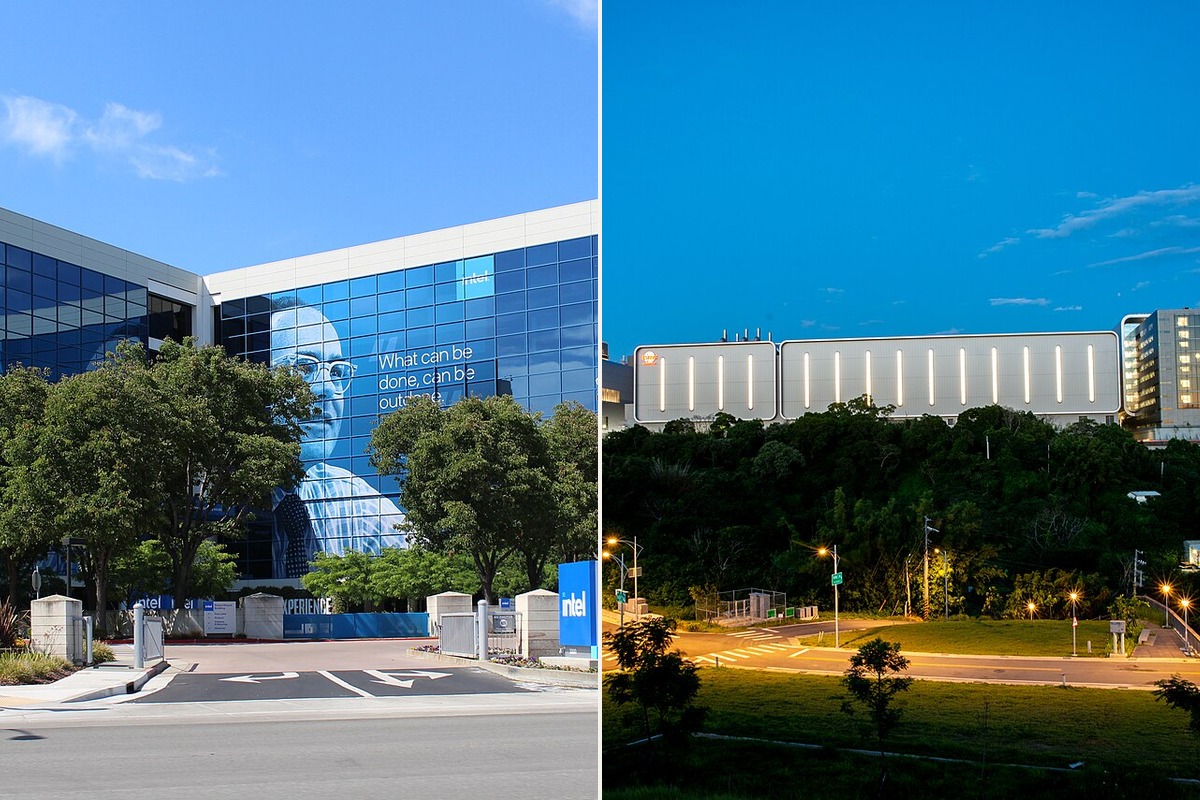
Images: Wikimedia Commons / B.p. & Tseng Cheng-Hsun, CC BY-SA 4.0, split composite, metadata removed
The Uncut Notebook on Substack
The Weekly Edition, plus what stays off this site: operator playbooks, uncut onchain wallet dossiers, and notes from the system behind this notebook. No spam, no paywall.
Subscribe on Substack ↗