19,700 Burger King stores still cannot open within 20 miles of Mattoon, Illinois
In 1957, Gene and Betty Hoots converted a two-car garage in Mattoon, Illinois into a burger stand called Burger King and registered an Illinois trademark two years before the Florida chain got its federal mark. Fifty-eight years after the Seventh Circuit's ruling in 403 F.2d 904, the 20-mile exclusion zone still stands.
 Tat Thang
Get the Weekly Edition by email: the signals that held up and the stories behind them. Free. Subscribe ↗
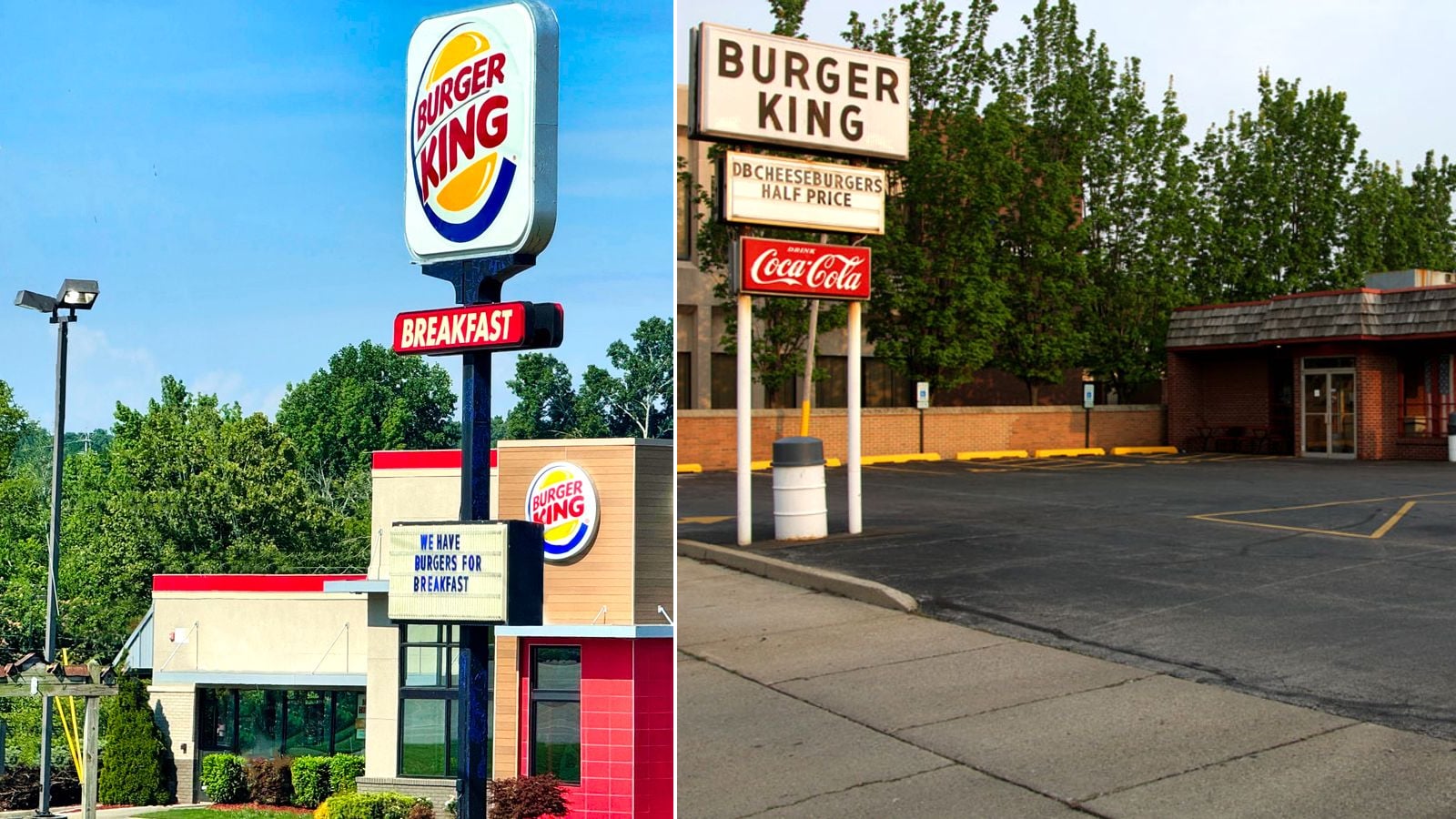
Open Google Maps today and search for Burger King in Mattoon, Illinois. You will find a single brick building at 1508 Charleston Avenue with a vintage white road sign advertising half-price double cheeseburgers. It has sold zero Whoppers in sixty-nine years.
To buy a Whopper from the multinational fast-food giant that operates 19,700 restaurants across more than 100 countries and 319 locations across Illinois, a Mattoon resident has to drive roughly 25 miles north up Interstate 57 to Tuscola.
The empty 40-mile diameter around Mattoon is not a demographic dead zone or a municipal boycott. It is a permanent federal court boundary carved out on November 25, 1968 by the U.S. Court of Appeals for the Seventh Circuit in Burger King of Florida, Inc. v. Hoots (403 F.2d 904).
Most founders and operators assume that scale and federal capital eventually flatten every local competitor. What happened in Mattoon proves the opposite. Under American trademark law, a dated piece of state paperwork paired with an unbroken operating clock creates what we call The Continuous-Use Moat: a statutory fortress where a global roll-up can buy the rest of the planet, yet remains legally locked out of the one zip code where a family grill lit its burners first.
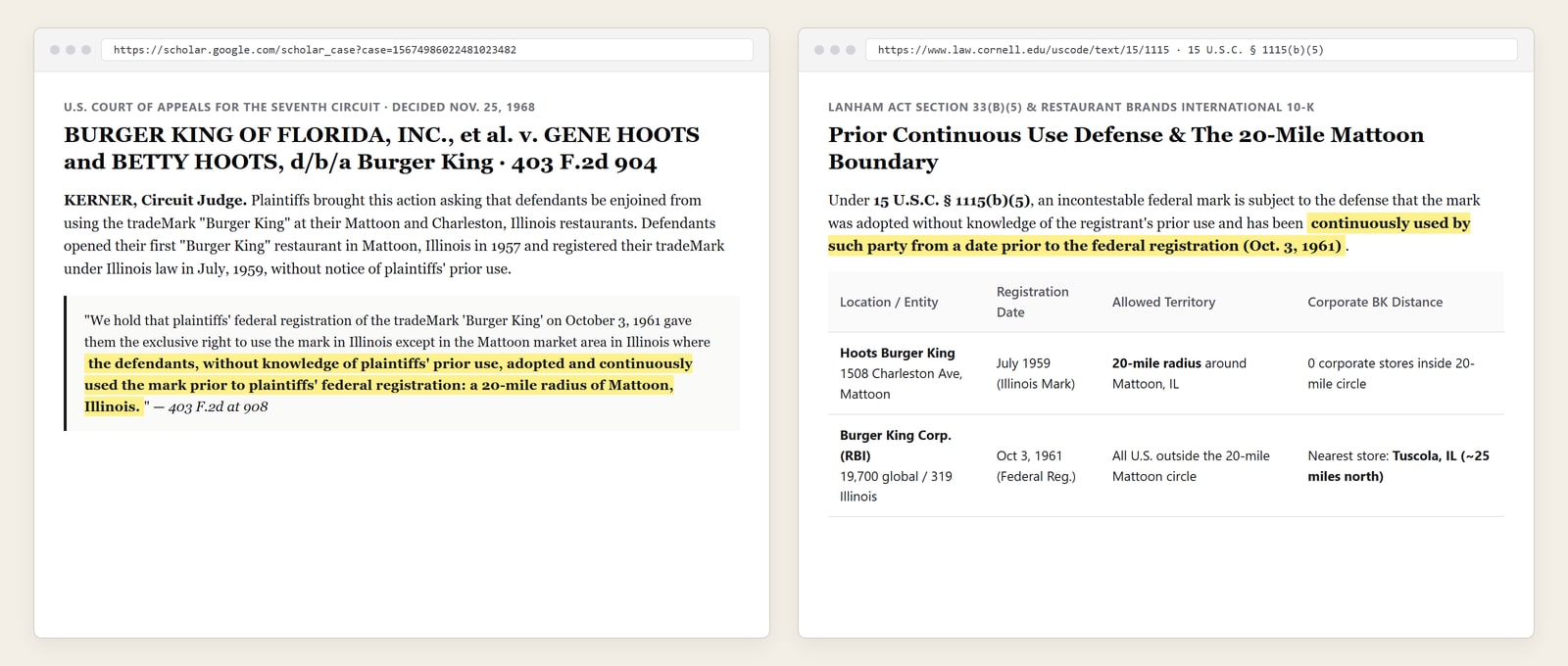
FIG. 01 · THE 20-MILE MATTOON MOAT
Burger King operates 19,700 restaurants globally and 319 in Illinois, but zero inside a 20-mile circle around Mattoon.
Federal trademark boundaries established by Burger King of Florida, Inc. v. Hoots, 403 F.2d 904 (7th Cir. 1968)
| Entity | Trademark registration | Territory granted | Store count today |
|---|---|---|---|
| Hoots Burger King (Mattoon) | July 1959 (Illinois state mark)Burger King of Florida, Inc. v. Hoots, 403 F.2d 904 | 20-mile radius around MattoonBurger King of Florida, Inc. v. Hoots, 403 F.2d 904 | 1 store (1508 Charleston Ave)Burger King of Florida, Inc. v. Hoots, 403 F.2d 904 |
| Corporate Burger King (US/Global) | Oct 3, 1961 (Federal Lanham Act)Burger King of Florida, Inc. v. Hoots, 403 F.2d 904 | All U.S. outside Mattoon zoneBurger King of Florida, Inc. v. Hoots, 403 F.2d 904 | 19,700 global (0 in Mattoon)Restaurant Brands International SEC Form 10-K |
Sources: Burger King of Florida, Inc. v. Hoots, 403 F.2d 904, Restaurant Brands International SEC Form 10-K. Under 15 U.S.C. 1115(b)(5), the Hoots family proved continuous prior commercial use in Mattoon since 1957. The nearest corporate Burger King sits ~25 miles north in Tuscola, Illinois.
A 1957 two-car garage beat the Miami franchise machine to the Illinois registry by 27 months
Follow the calendar and the cash register at 1508 Charleston Avenue.
In 1952, Gene and Betty Hoots bought a small Mattoon ice cream stand called Frigid Queen from Gene’s uncle, Bill Paullin. Two years later, Gene bolted a grill into the back room to serve hamburgers and French fries when winter weather slowed ice cream sales. By 1957, hamburger orders had outgrown the ice cream counter, so Gene and Betty converted a two-car garage right behind Frigid Queen into a dedicated burger shop. Reasoning that every Queen needs a King, they painted “Burger King” on the sign.
In July 1959, Gene Hoots paid the filing fee to register “Burger King” as an official Illinois state trademark.
At that moment, the corporate Burger King chain (founded in Jacksonville, Florida in 1953 and expanding out of Miami) had zero restaurants in Illinois. The Florida chain did not open its first Illinois store in Skokie until July 1961, and did not obtain its federal Lanham Act trademark registration until October 3, 1961, twenty-seven months after the Hoots family locked in their Illinois certificate.
By 1967, the Florida chain had grown to 50 restaurants across Illinois and moved to clear the map. According to Betty Hoots, corporate representatives offered $10,000 to buy out their name in Mattoon. Gene and Betty refused. When the corporation sued in federal court, its president walked into the courtroom flanked by at least six attorneys; Gene and Betty sat with a single local Mattoon lawyer, Harlan Heller.
Section 1115(b)(5) of the Lanham Act draws a 20-mile circle that $30 billion cannot cross
When the case reached the Seventh Circuit in 403 F.2d 904, the appellate panel had to resolve a direct collision between two statutes: the national constructive notice of the federal Lanham Act and the common-law property rights of an innocent prior user.
“Plaintiffs' federal registration of the tradeMark 'Burger King' on October 3, 1961 gave them the exclusive right to use the mark in Illinois except in the Mattoon market area in Illinois where the defendants adopted and continuously used the mark.”
Writing for the Seventh Circuit, Judge Otto Kerner Jr. split the map in two:
- The Federal Border Outside Mattoon: Once corporate Burger King secured its federal registration on October 3, 1961, it acquired exclusive rights across the entire United States outside of the Hoots family’s established market area. Because Gene and Betty had opened a second Burger King in nearby Charleston, Illinois in 1962 (one year after the federal registration), the court forced the Hoots family to close or rename the Charleston shop.
- The 20-Mile Fortress Inside Mattoon: Under Section 33(b)(5) of the Lanham Act (15 U.S.C. 1115(b)(5)), any operator who adopted a mark in good faith without knowledge of an outside registrant and used it continuously before the federal registration date retains an absolute, exclusive right to that market area. The court fixed that boundary as a 20-mile radius centered on Mattoon.
Inside those 1,256 square miles of central Illinois, the multinational corporation is the infringer, and the converted garage is the rightful Burger King.
A prior-use moat survives on physical geography, or scales globally when borders disappear
Consider the sharpest objection to the Mattoon precedent: if the Hoots family won, why were they trapped inside a single 20-mile circle while corporate Burger King grew to 19,700 stores?
Look at the math of territorial vs. borderless property rights across two control groups:
- Physical Geography (Mattoon, Illinois and Adelaide, Australia): In physical retail, trademark priority is bounded by the jurisdiction where you register before the giant arrives. In Mattoon, an Illinois state mark plus local foot traffic yielded a 1,256-square-mile circle (a 20-mile radius). Three years later in 1971, when Miami-based Burger King tried to enter Australia, it discovered that an Adelaide shop owner already held the national Australian trademark for “Burger King,” forcing the American corporation to rename its entire Australian network of more than 440 stores to Hungry Jack’s.
- Borderless Geography (Nissan.com): When Uzi Nissan registered nissan.com in May 1994 for his Raleigh computer shop before the Federal Trademark Dilution Act of 1996 existed, the DNS root had no 20-mile radius. Winning prior-use priority on a global namespace locked Nissan Motor Co. out of its exact-match dot-com across the entire planet.
There is only one way to lose a Section 1115(b)(5) moat: abandonment. Under federal law, if the grill at 1508 Charleston Avenue ever goes cold permanently and ceases commercial use of the name, the 20-mile exclusion zone evaporates for $0. Gene and Betty Hoots kept the fryers running for nearly six decades before retiring in 2015 and passing the building and its grandfathered trademark to local operators who still flip the signature Hoot burger today.
Sources & image credits (5)
What would prove this wrong
This dossier is falsified if the independent Mattoon Burger King at 1508 Charleston Avenue permanently abandons commercial use of the mark under 15 U.S.C. 1115(b)(5), allowing Restaurant Brands International to open a corporate Burger King inside the 20-mile Mattoon radius.
Sources
- [1] Burger King of Florida, Inc. v. Hoots, 403 F.2d 904 (7th Cir. Nov. 25, 1968) ↗
- [2] Restaurant Brands International Inc. SEC Filings (CIK 0001618756) ↗
- [3] Lanham Act Section 33(b)(5), 15 U.S.C. 1115(b)(5): Prior Continuous Use Defense ↗
- [4] Nissan Motor Co. v. Nissan Computer Corp., 378 F.3d 1002 (9th Cir. 2004) ↗
Images: Wikimedia Commons / Nyttend & Harrison Keely, CC BY-SA 4.0, split composite, metadata removed
The Uncut Notebook on Substack
The Weekly Edition, plus what stays off this site: operator playbooks, uncut onchain wallet dossiers, and notes from the system behind this notebook. No spam, no paywall.
Subscribe on Substack ↗